


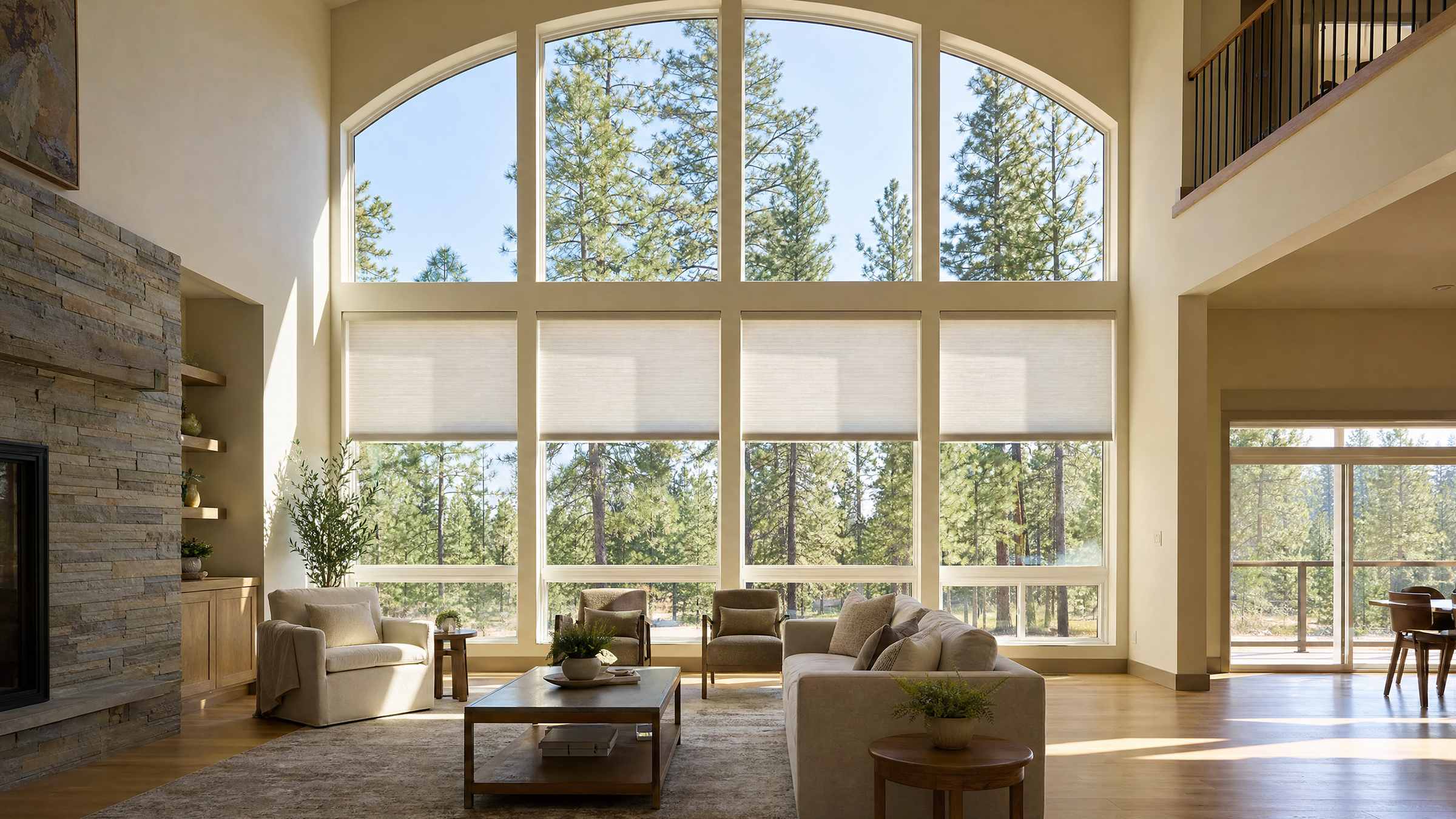
Architectural shades are custom Hunter Douglas shades built for windows that standard coverings can't handle: arches, skylights, very tall windows, and large openings. They come in several familiar collections, including Silhouette, Luminette, roller, and honeycomb, scaled up with stronger hardware. On anything you can't reach from the floor, motorization is usually the practical way to run them.
If you've got a window that made you wonder whether anyone sells a shade for it, it probably belongs here. The common ones are:
Architectural work isn't a single product. Hunter Douglas offers it across several of its collections, including Silhouette, Luminette, roller shades, and honeycomb shades, built to work at larger sizes. So you can often keep the look you've chosen for the rest of the house and carry it onto the unusual window.
There's also a fabric-covered batten style, which pairs the clean look of a roller shade with fabric-wrapped battens. It has no cords and no stacking fabric.
Fabrics run from sheer to room-darkening and opaque, so the choice mostly comes down to what the room needs. A two-story living room might want soft filtered light all day, while a primary bedroom with a tall window needs more coverage.
Specialty shapes can get either fixed or operational panels. A fixed panel stays in place and covers the shape full time. An operational one moves. Which you'd want depends on the window and how you use the room, so we'd work through it with you at the window.
On a tall window, the honest question is how you'd reach it. Motorization lets you raise and lower the shade from a remote or your phone, without ladders or extended reach.
Hunter Douglas PowerView adds a bit more on big projects. You can group all the shades in a room and move a whole wall of windows with one tap, or save scenes for different times of day. Spokane's long, bright summers give that real use on west and south-facing glass. Here's how PowerView automation works.
Large windows let more sun reach more of your floors and furniture, and fading follows that. How much UV a shade filters depends on the fabric, so bring it up if you've got wood floors, upholstery, or art near the glass, and we'll show you options that cover the whole opening.
Measuring matters more than usual on these. Each shade is built to the specifications of one window, so the measurements have to be right, and windows like these don't leave much room for error. The hardware and mounting systems are reinforced to carry the extra weight and span, and our team checks that every shade hangs level and runs smoothly before we leave.
We also work with homeowners, architects, and interior designers, so if you're building or remodeling, it helps to bring us in while the plans can still change.
We don't publish a number for architectural shades, because the windows vary too much. Here's what moves the price:
For a sense of scale, our motorized price guide lists ranges for standard motorized shades and notes that a tall great-room window sits at the top of those ranges.
Not every big window needs an architectural solution. A wide picture window often does fine with a standard product, like Pirouette or Silhouette shades. Our guide to window coverings for different types of windows is a good place to start.
Take a look at our architectural shades page, then book a free in-home consultation. We'll look at the actual window, measure it, and give you an exact quote. You can also stop by our Spokane Valley showroom to see working motorized shades.
They're custom Hunter Douglas shades built for windows of unusual size or shape, including arches, skylights, very tall windows, and large openings.
Yes. Half-rounds, eyebrows, quarter circles, and triangles can be fitted with fixed or operational panels built to that shape.
Motorization is usually the most practical way. You can raise and lower the shade from a remote or smartphone, and PowerView can group a whole wall of shades to move together.
Silhouette, Luminette, roller shades, and honeycomb shades are all available, engineered to work at larger window dimensions.
It depends on window size and shape, fabric, access, and motorization. We don't publish a range because the windows vary so much. A free in-home consultation gets you an exact quote.
Yes. We work with homeowners, architects, and interior designers on architectural window projects in the Spokane area.
Have more questions? Spokane Blinds offers free in-home consultations across Spokane and the Inland Northwest.
