


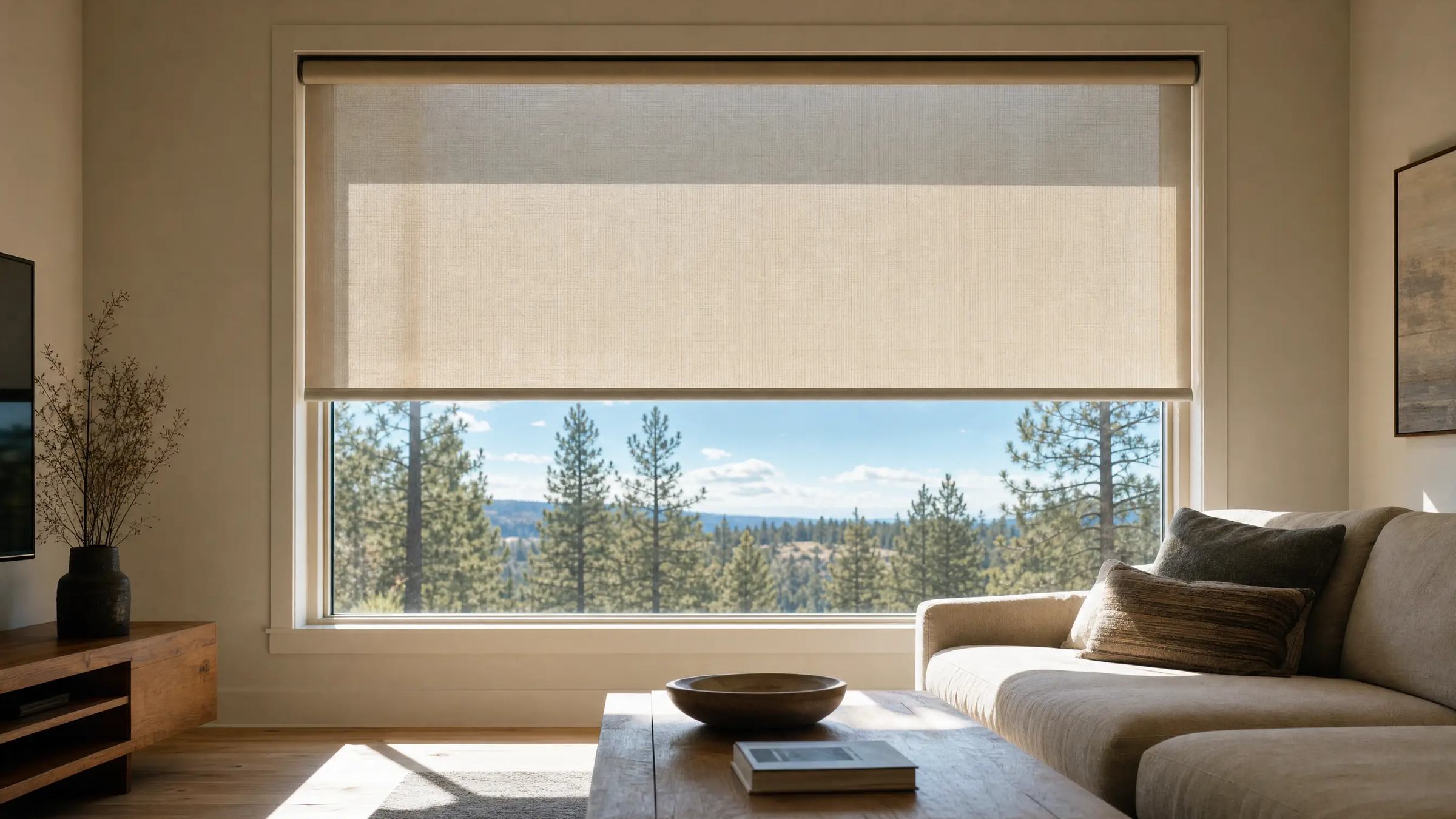
Roller shades are a custom-built fabric shade on a single roll, available through Spokane Blinds in more than 400 fabrics spanning sheer to fully opaque. The fabric you choose determines almost everything about how the shade performs: how much light gets through, how much privacy you get, and how well it blocks UV. Everything is cut to your window's exact size and mounted with a precision roller mechanism, which is the main thing separating a custom roller shade from a stock one you'd find pre-cut at a hardware store.
A pre-cut roller shade from a big-box store comes in a handful of standard widths, and most windows don't match one exactly. That leaves a visible gap on one or both sides, which defeats the point of a shade meant for privacy or light control in the first place. A custom roller shade is measured to your actual window and built to that measurement, edge to edge, with no trimming or guessing involved. A close fit also matters most in a bedroom, where blackout fabric only works as well as the coverage around it.
Light-filtering fabrics soften and diffuse incoming sunlight without shutting the room off from the outside, and they're the default choice for living rooms, dining rooms, and home offices where you still want a bright space. Room-darkening fabrics cut most of the incoming light while stopping short of complete darkness, a useful middle ground for a media room or a bedroom where you want dim rather than pitch black. Blackout fabrics are made for bedrooms, nurseries, and home theaters where darkness is the priority, and side channels are available on many options to block light around the edges.
Standard roller shades cover most windows without issue, but Spokane homes with arched openings, very tall windows, or oversized picture windows sometimes need something built for that scale. Hunter Douglas offers roller shades through its Architectural Shades line specifically for those situations, with reinforced hardware designed to handle the added weight and span. If your window doesn't fit a standard roller shade cleanly, that's worth asking about at your consultation rather than assuming it's off the table.
Roller shades work well as a standalone treatment, but they also layer cleanly beneath drapery panels if you want a more finished, fuller look in a formal living or dining room. The roller shade handles the daily light and privacy work, while the drapery adds softness and frames the window when it's open. It can work well on taller windows, where the shade does the functional work under the fabric panels.
If you've come across banded shades (also called zebra shades) while researching roller shades, they're a related but different product: alternating sheer and solid fabric bands on a roller, which let you shift between filtered light and full privacy without changing shades. A standard roller shade gives you one fabric and one opacity per shade. A banded shade gives you two effects in one. We've written a full breakdown in our banded shades guide if you're weighing the two against each other.
If you searched something like "silhouette roller blinds," it's worth knowing these are two separate Hunter Douglas products, not one. Silhouette is a sheer fabric shade with vanes floating between two sheer panels, built for soft, diffused light. Roller shades are a single continuous fabric on a roller mechanism, built for a cleaner, flatter look and a wider range of opacities including true blackout. We cover the difference between Silhouette and its close relative Pirouette in our Silhouette versus Pirouette guide, which is useful background if you're deciding between a sheer shade and a roller shade generally.
Spokane Blinds sells several shade categories that solve a similar problem in different ways, and it's worth knowing where a roller shade fits among them before you settle on one. Honeycomb shades add more insulation than a roller shade because of their cell structure, which matters more here given Spokane's cold winters. Banded shades give you a built-in privacy and light-filtering toggle in one product, something a single-opacity roller shade can't do on its own. Roller shades stand out for their clean look and the range of fabric choices, with more than 400 options.
Roller shades operate on a smooth rolling mechanism that holds its position without drift. Cordless lift and PowerView motorization are both available, and motorization is a particularly practical upgrade here, since it lets you schedule shades to open with the morning and close for privacy in the evening without touching a cord. Cordless and motorized options both remove dangling cords as a hazard for homes with kids or pets.
Room-darkening and blackout fabrics provide the strongest UV protection, but even light-filtering fabrics reduce UV significantly compared to bare windows. South- and west-facing windows get the most sun exposure, so that's where a roller shade does the most to protect floors and furniture.
With more than 400 fabric options, a roller shade is hard to shortlist from a website. Spokane Blinds brings physical fabric samples to your home during a free in-home consultation, where you can compare opacity and color against your actual walls and furniture, or visit the Spokane Valley showroom to see the collection directly.
Spokane Blinds carries over 400 roller shade fabrics, ranging from sheer to fully opaque, across a wide range of colors, patterns, and textures.
Light-filtering fabric softens sunlight while keeping the room bright. Room-darkening fabric cuts most light without full darkness. Blackout fabric blocks nearly all incoming light and is the standard choice for bedrooms.
No. A standard roller shade uses one fabric and one opacity. A banded, or zebra, shade alternates sheer and solid bands on the same roller, letting you shift between filtered light and full privacy without switching shades.
Architectural Shades is a Hunter Douglas product line built for oversized or unusually shaped windows, including arches and very tall openings, using reinforced hardware to handle the added weight and span of a larger installation.
Two separate products. Silhouette is a sheer fabric shade with floating vanes between two sheer panels. Roller shades are a single fabric on a roller mechanism. They're often searched together but built and priced differently.
Yes, with Hunter Douglas PowerView, which allows scheduling and control from a remote or smartphone app. Cordless lift is also available for homes that don't need motorization.
Blackout fabric is made for bedrooms, nurseries, and home theaters where darkness is the priority. Each shade is custom cut to your window, and side channels are available on many options to block light around the edges.
Have more questions? Spokane Blinds offers free in-home consultations across Spokane and the Inland Northwest.
