


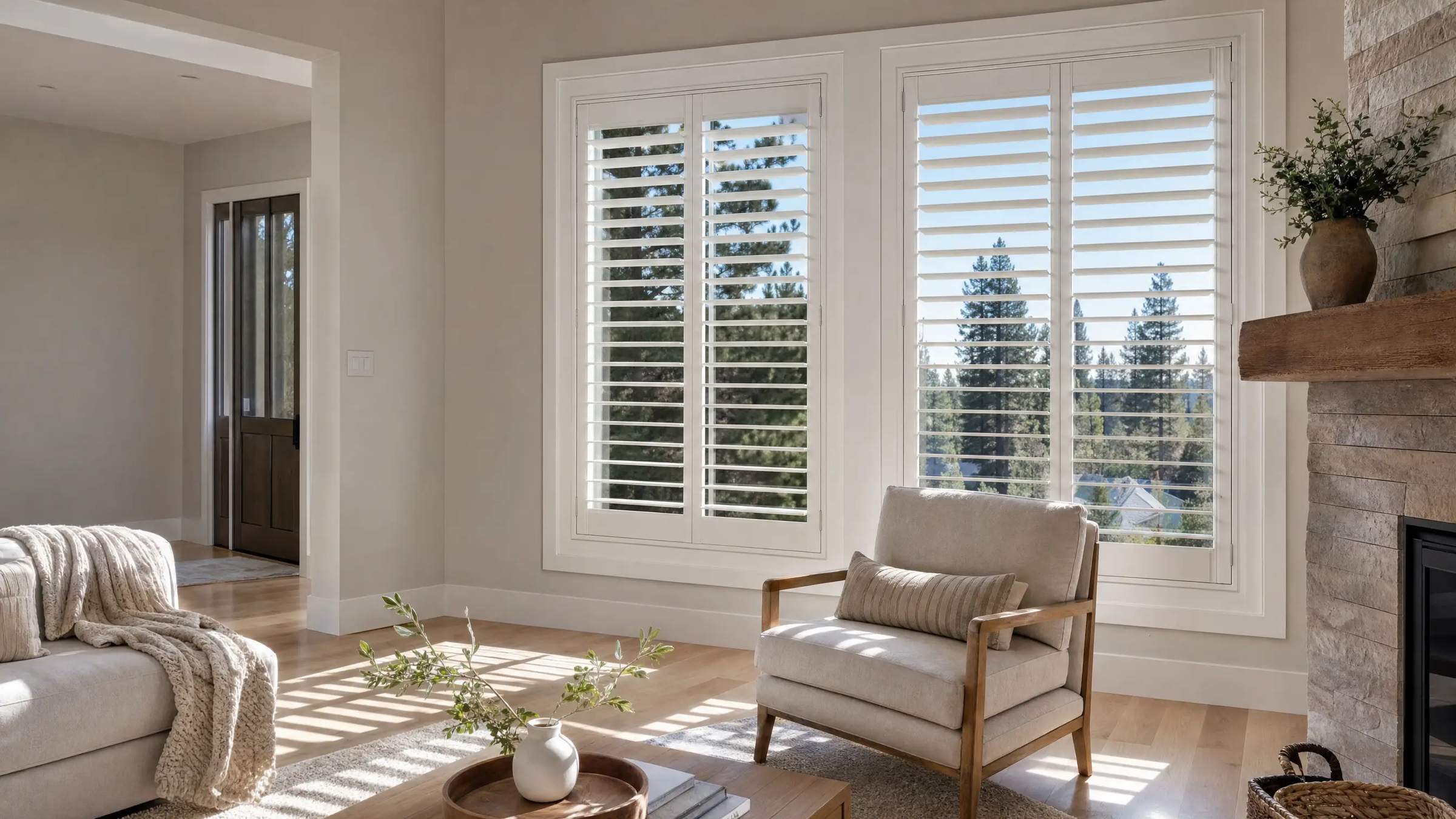
Custom shutters in Spokane come in three materials: hardwood, hybrid, and polysatin. All three are built to your exact window openings rather than sold off a shelf, which is the main thing that separates a shutter from a blind or a shade. The material you pick depends mostly on the room: hardwood for the rooms where you want real wood grain, polysatin for bathrooms and kitchens where moisture is a factor, hybrid when you want the wood look with more durability. Cost moves with material, louver size, and how many windows you're covering, not a flat per-window rate.
A shutter is a set of hinged panels with tilting louvers, built into a frame that's fitted to your window. That construction is what gives shutters their reputation for adding real value to a home. They read as part of the house rather than something hung in front of it, in the way that curtains and even quality blinds don't quite manage. They're built for durability, with no fabric to fade unevenly and no cord mechanism to wear out. We've written more on how shutters compare to blinds and on how shutters affect home value if you want the fuller case for either question. This piece is about the buying decision itself: what to choose and why.
Hardwood shutters are milled from real wood species and finished to order, in either paint or stain. They're the choice for rooms where the wood grain itself is part of the look, and they hold their shape and finish for decades with basic care. They're not the pick for a bathroom or a kitchen sink window, where humidity and splashing water are a factor.
Polysatin shutters are made from a waterproof compound rather than wood, which makes them the right call for bathrooms, laundry rooms, and any kitchen window near the sink or range. They resist warping, cracking, and yellowing in a way wood can't, and they hold their finish without the upkeep wood shutters need.
Hybrid shutters pair a hardwood core with a moisture-resistant composite exterior, aiming for the look of real wood with more resistance to humidity than solid hardwood offers. It's a middle option worth asking about if you like the wood look but the room isn't a dry one.
Louvers on all three materials run from roughly 2.5 inches up to 4.5 inches. Smaller louvers read as more traditional and work well on smaller or more classically styled windows. Larger louvers open up a bigger view and let in more light when open, and they suit larger windows and more contemporary interiors. Your consultant will walk you through samples of each size against your actual windows, since photos don't really convey the difference.
Shutters are priced by the window, not by the house, and a few factors move that price more than anything else. Material is one lever, since hardwood, hybrid, and polysatin are priced differently. Louver size matters too, since larger louvers use more material per panel. Window count and total square footage are the other obvious factors. Beyond that, panel configuration (full height, cafe style, or bi-fold for wide openings) adds or removes cost depending on complexity. We won't put a number on this in a blog post, because it would be wrong for your specific windows. A free in-home consultation gets you an exact, measured quote.
Because every shutter is custom manufactured to your window's exact dimensions, there's a lead time between ordering and installation that varies by material and current manufacturing volume. Your consultant will give you a timeline for your specific order. Our installation guide walks through how measuring, ordering, and installation work.
The consultation itself is where the real decisions happen. A consultant comes to your home with material and louver samples, measures your windows precisely, and helps you match material to room: hardwood where you want the wood look, polysatin or hybrid where moisture is a factor. You'll also settle on frame style, finish, and whether any windows need a specialty configuration like bi-fold panels for a wide opening.
Shutters aren't limited to a single flat panel per window. Full-height panels are the standard configuration for most windows. Cafe-style panels cover only the lower half of the window, leaving the top open for light while still giving privacy at eye level, a configuration some homeowners like for a kitchen or a street-facing living room. Bi-fold panels fold back in sections and are built for wider openings, including sliding doors, where a single rigid panel would be impractical to operate. Your consultant will recommend a configuration based on the window's size and how you actually use the room, not just its dimensions.
All three materials come in a range of paint and stain finishes, from crisp white to deeper wood tones, and the finish decision is usually made alongside the louver size rather than before it. A wider louver in a darker stain reads more dramatic and contemporary. A narrower louver in white or a light finish reads more traditional. Bringing samples to your actual walls and trim during the in-home consultation is the only reliable way to judge how a finish will look once it's installed, since lighting in a showroom rarely matches your home's.
Living rooms and dining rooms are the classic fit for hardwood, especially in older Spokane and Spokane Valley homes where a built-in look matters. Bathrooms and kitchens are where polysatin earns its keep, since it shrugs off the humidity that would eventually warp or crack a wood product. Spokane's cold winters are also a practical argument for shutters generally: because they mount directly to the frame, they add a layer of insulation at the window that curtains and most blinds don't provide in the same way.
Once you've narrowed down materials, the fastest way to compare them in person is a visit to the Spokane Valley showroom or a scheduled free in-home consultation, where we bring the samples to you.
Hardwood is real wood, best for dry rooms where the grain matters. Polysatin is a waterproof compound built for bathrooms and kitchens. Hybrid combines a hardwood core with a moisture-resistant exterior for a middle option. All three are custom-built to your window's exact dimensions.
Shutters cost more upfront but are built into the window frame and typically outlast blinds by years, with no cords or fabric to wear out. For the fuller comparison, see our post on shutters versus blinds.
Louvers generally range from about 2.5 inches to 4.5 inches across our hardwood, hybrid, and polysatin lines. Smaller louvers suit a traditional look and smaller windows. Larger louvers open up more view and light on bigger windows.
Yes, with the right material. Polysatin shutters are built to handle the humidity and splashing that would eventually warp or crack a wood product, which makes them the standard recommendation for those rooms.
Cost depends mainly on material, louver size, and the number and size of your windows, plus any specialty panel configurations. We don't quote a price without measuring, since the range is wide, but a free in-home consultation gets you an exact number.
A consultant brings material and louver samples to your home, measures each window precisely, and helps you choose material, louver size, finish, and panel configuration based on the room. That measurement is also what the manufacturing order is built from.
Because shutters mount directly to the window frame rather than hanging in front of it, they add a layer of insulation at the window that helps in cold weather, on top of their light and privacy control.
Have more questions? Spokane Blinds offers free in-home consultations across Spokane and the Inland Northwest.
